
Constipation gets much of the attention when people talk about GLP-1 medications. It’s easy to notice, easy to name, and — in theory — easy to address.
But what if constipation is only the dashboard light?
Underneath it, something more interesting is happening. GLP-1 medications can change hunger, fullness, stomach emptying, food intake, and the pace of digestion. Those shifts can affect not only when you have a bowel movement, but how food, microbes, and the gut lining meet along the way.
To understand why, it helps to start with a deceptively simple question: What is GLP-1, and what are these medications actually doing?
A quick safety note: This article is educational and is not medical advice. Do not stop or change a prescribed medication without speaking with your clinician. Seek prompt care for severe or persistent constipation, intense abdominal pain, repeated vomiting, fever, blood in the stool, or an inability to keep fluids down.
First: what is GLP-1?
GLP-1 stands for glucagon-like peptide-1. It is a hormone your body naturally releases in response to food. Think of it as one member of the post-meal communication team.
After you eat, naturally produced GLP-1 helps:
- Signal that nutrients have arrived
- Support insulin release when blood sugar is elevated
- Reduce glucagon, a hormone that prompts the liver to release stored glucose
- Increase feelings of fullness
- Slow the rate at which food leaves the stomach
In everyday language: GLP-1 helps tell the body, Food is here. Manage the incoming energy. You do not need to keep searching for more right now.
GLP-1 medications are designed to act on this system. They are used for conditions including type 2 diabetes and, in certain formulations, weight management. Unlike the body’s short-lived, meal-timed GLP-1 signal, these medications are engineered to keep working much longer. That extended action is a feature, not a mistake. It is part of what makes them useful.
What are GLP-1 medications “stopping”?
Well, they aren’t really “stopping” anything. GLP-1 medications turn down certain signals and slow certain steps:
- Hunger may become less urgent.
- Fullness may arrive sooner and last longer.
- The stomach may empty more slowly.
- Glucagon signaling may decrease when blood sugar is elevated.
- Food intake — and therefore fluid, fiber, and nutrient intake — may decline.
Meanwhile, digestion continues. The stomach still churns. Enzymes still break food down. The small intestine still absorbs nutrients. The colon still reclaims water and houses a dense microbial community.
The difference is pace. And pace, much like music, can change the whole experience.
The useful question is not “Is digestion on or off?” It is “How has the timing changed?”

Your digestive system is an orchestra
While discussing the impact of a simple meal on digestion, ION* Chief Science Advisor, Dr. John Gildea, compares the endocrine system to music. A meal does not press one key; it triggers a symphony of chords.
The sight and smell of food prepare the nervous system. Chewing and swallowing begin mechanical breakdown. The stomach mixes food and releases it gradually. The small intestine receives nutrients, digestive secretions, and hormonal signals. Then, between meals, different patterns of muscular movement help clear residual material forward.
Hunger, eating, digesting, absorbing, moving, and resetting are different movements in the same composition.
A GLP-1 medication does not silence the orchestra. It holds certain notes longer. For many people, that creates valuable effects: steadier blood sugar, less “food noise,” earlier fullness, and meaningful weight loss. But when one part of a coordinated system changes, other parts may need time — and support — to find a new rhythm.
That is why digestive symptoms can overlap. Nausea may make fluids unappealing. Early fullness can shrink meals. Smaller meals may mean less fiber and less total volume moving through the gut. Slower stomach emptying can make a sudden fiber increase feel more uncomfortable, not less.
Constipation may be the final symptom, but it is rarely the entire story.
For practical relief strategies, see our guide to GLP-1 constipation. To follow the story farther through the digestive tract, keep reading below…
Why movement matters after food leaves the stomach
Slower stomach emptying is only one part of the digestive picture. Once food leaves the stomach, coordinated muscular movement—called motility—continues carrying it through the intestines.
Motility affects how long food stays in each area, how well it mixes with digestive secretions, and when it reaches the microbes that help process what remains. We tend to notice this movement only when we feel constipated or bloated, but its everyday role is to keep each stage of digestion moving in the right order.
That order matters because the digestive tract is not one uniform tube:
- The stomach stores, mixes, and begins breaking down a meal.
- The small intestine handles most digestion and nutrient absorption.
- The colon reclaims water and electrolytes and houses most of the gut’s microbial community.
In other words, movement does more than help you stay regular. It also helps food (and the microbes that interact with it) spend time in the places best suited to their jobs.
The microbiome has an address

We often talk about the microbiome as a list of organisms: which ones are present, and whether they are considered helpful or harmful. But location matters too.
Think of the small intestine and colon as neighboring communities with different jobs. The small intestine is primarily a place for digesting food and absorbing nutrients, so it normally contains fewer microbes. The colon is designed to support a much larger microbial population, which helps ferment material the body did not absorb earlier.
Regular movement, digestive secretions, immune activity, and the gut barrier all help maintain that distinction. When digestive timing changes, the environment may feel different — even if there is no single disorder to blame.
That does not mean GLP-1 medications automatically cause dysbiosis or small intestinal bacterial overgrowth (SIBO). Constipation, bloating, and abdominal discomfort can have many causes, and symptoms alone cannot diagnose a microbial problem. The more useful takeaway is simply that motility helps preserve the gut’s organization.
Gut health is not only about which microbes are present. It is also about where they are — and how long they stay there.
Where two digestive worlds meet
The clearest example of this organization appears where the small intestine meets the colon. At the end of the small intestine is the terminal ileum; just beyond it begins the colon. The ileocecal region sits between them like a border crossing.
On one side, the body is finishing nutrient absorption. On the other, a dense microbial community is ready to ferment what remains. The gut lining spans this transition, continually interacting with food particles, microbial byproducts, and immune signals.
You do not need to remember the anatomy. The practical point is that digestive health depends on timing and boundaries — not only on what you eat.
This is also why the gut lining belongs in the conversation. Not because GLP-1 medications have been shown to damage it, but because changes in appetite, meal size, and digestive timing can change the conditions surrounding it.
Work with the new pace, not against it
So what does this mean day to day? Rather than trying to “fix” the microbiome or force digestion to move faster, start by supporting the basic conditions that help the digestive system adjust to a different pace.
If digestion is moving differently, the answer is rarely to push harder. It is to make the fundamentals easier for the body to use.
1. Hydrate in smaller, steadier amounts
Large drinks may feel uncomfortable when fullness or nausea is high. Sip fluids throughout the day. Soups, broth, melon, cucumber, and cooked fruit can also contribute fluid if tolerated.
If you have kidney, heart, or electrolyte concerns, follow your clinician’s guidance.
2. Make smaller meals count
When appetite drops, nutrition can quietly drop with it. Rather than forcing a large plate, build smaller meals or mini-meals around:
- A protein source
- A well-tolerated plant food
- A modest source of soluble fiber
- Fluids alongside or between meals, based on comfort
The goal is not a perfect menu. It is enough nourishment, consistently.
3. Treat fiber like a dial, not a switch

A sudden jump in fiber can add bulk faster than a slower-moving system can comfortably handle. Begin with smaller portions of gentler soluble-fiber foods such as oats, chia, ground flax, kiwi, berries, cooked carrots, zucchini, or sweet potato.
Increase gradually. If pressure, bloating, or discomfort rises, turn the dial back.
4. Let movement provide a cue
A short walk after a meal may be more useful — and more realistic — than an intense workout when nausea or fatigue is present. Gentle, regular movement supports the body’s overall digestive routine.
5. Find a repeatable meal rhythm
Some people feel worse when grazing constantly; others struggle to meet their needs with long gaps between meals. A predictable pattern of small meals can provide useful digestive cues without requiring rigid timing.
6. Know when “more” is not the answer
Persistent or worsening symptoms deserve medical guidance, not an ever-growing stack of fiber, laxatives, supplements, and food restrictions. A prescriber can assess the medication, dose, symptom pattern, hydration status, and whether something else needs attention.
Where ION* fits: support the interface

By now, the product connection should feel less like a detour.
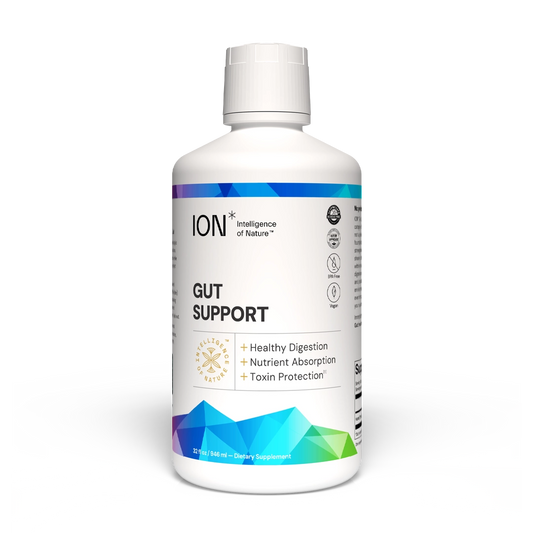
A GLP-1 medication acts on metabolic signaling. ION* Gut Support does not perform that job, cancel it, or reverse medication side effects. It is not intended to speed stomach emptying or treat constipation.
ION* is focused on a different part of the story: the gut lining (the living interface where the body meets food, microbes, and microbial metabolites).
That interface matters every day, but it can be easy to overlook when appetite, meal size, and digestive timing are changing. A foundation-first routine supports the conditions around digestion rather than chasing each symptom in isolation:
- Adequate nourishment gives the system material to work with.
- Hydration and tolerable fiber support movement and stool consistency.
- Gentle activity and meal rhythm provide physical cues.
- Clinician-guided care keeps medication decisions where they belong.
- Gut-lining support helps care for the interface where these worlds meet.
ION* Gut Support is designed to support the gut lining and the digestive environment. Think of it as one supportive layer within the larger routine.
Three questions with Dr. John Gildea

What is the biggest misconception about GLP-1 medications and digestion?
That digestion is a single switch. It is a sequence of signals and movements. GLP-1 medications can be effective because they change parts of that sequence, but their digestive effects cannot be understood through appetite alone.
Why should people care about motility beyond constipation?
Motility helps organize the digestive ecosystem. It affects when food reaches each region, how long it stays there, and how microbes interact with the gut lining. Regularity is one visible outcome; timing and location matter too.
Where does gut-barrier support fit?
The barrier is the interface connecting digestion, microbes, and the immune system. It helps care for the foundation on which digestive health depends.