
Your daily moisturizer, perfume, and makeup may carry hidden toxins. Learn what's lurking in your beauty routine and how to protect your skin barrier.
Most of us don't think twice about the products we reach for every morning. A spritz of perfume. A swipe of foundation. A gentle moisturizer before heading out the door. These rituals feel like self-care — and in many ways, they are.
But there's a conversation the beauty industry hasn't always been upfront about. The products we apply daily — sometimes nine to fifteen of them before leaving the house — can carry a cumulative load of synthetic ingredients that the body has to contend with. Not every ingredient is a problem. But some are worth knowing.
The beauty routine has a hidden guest list
Your skin is your body's largest barrier. It's not passive — it's an active system working constantly to keep irritants out while maintaining moisture and balance within. What lands on your skin's surface doesn't just sit there. Depending on the ingredient and its molecular size, it can interact with that barrier in ways that matter.
The issue isn't any single product. It's the accumulation. A preservative here. A synthetic fragrance there. A UV filter on top of that. Individually, each might fall within regulatory limits. Together, the picture gets more complex — and less studied.
Here's what's worth paying attention to.

Synthetic fragrance — the catch-all ingredient
When you see "fragrance" or "parfum" on an ingredient label, you're looking at a single word that can legally represent hundreds of undisclosed chemicals. This isn't a niche concern — it's standard industry practice.
Among the chemicals often hiding under that umbrella are phthalates, compounds used to help scent last longer on the skin. Research from the Environmental Working Group and peer-reviewed studies has raised questions about phthalates and their potential to interact with the body's hormonal communication pathways — particularly in the context of cumulative, long-term exposure.
The straightforward fix: look for products that disclose their fragrance components, or choose fragrance-free formulas.
Looking to go even further? Check out our fave homemade sunscreen recipe!
Parabens and the preservative load
Parabens are preservatives — they extend the shelf life of moisturizers, shampoos, and cosmetics by preventing bacterial and fungal growth. For decades, they were considered safe and unremarkable.
More recent research has drawn attention to their structural similarity to estrogen. Studies have found parabens present in human tissue, prompting questions about how they may affect the body's natural hormonal signaling over time. While regulatory bodies have not banned most parabens outright, many formulators have moved away from them in response to consumer awareness.
Reading labels helps: methylparaben, propylparaben, and butylparaben are the most common forms.
Heavy metals in makeup
Independent testing — including work from the EWG and academic institutions — has found trace levels of lead, arsenic, and cadmium in everyday makeup products including lipstick, eyeshadow, and foundation. These aren't intentional additives. They typically enter products through pigment sourcing, a systemic issue across the industry.
The concern is cumulative exposure over years of daily application, particularly for products used on the lips or around the eyes. Choosing brands that conduct third-party heavy metal testing is one of the most practical steps a consumer can take.
Your skin barrier is doing a lot of work
Before we move to what you can do, it's worth understanding what the skin barrier actually is — and why it deserves the same attention we give everything else in our health routines.
The skin barrier is the outermost layer of your skin, made up of cells and lipids that act as a gatekeeper. It decides what gets in and what stays out. When that barrier is intact and functioning well, it does its job quietly. When it's compromised — by over-exfoliation, harsh surfactants, environmental stress, or repeated exposure to disruptive ingredients — absorption increases and sensitivity rises.
Signs your barrier may be under stress include redness that lingers, persistent dryness that moisturizers don't seem to address, or reactions to products you've used comfortably before. These aren't random. They're your skin communicating.
What supporting the skin barrier actually looks like
Barrier support isn't about adding more. Often, it's about removing what disrupts — and strengthening what seals.
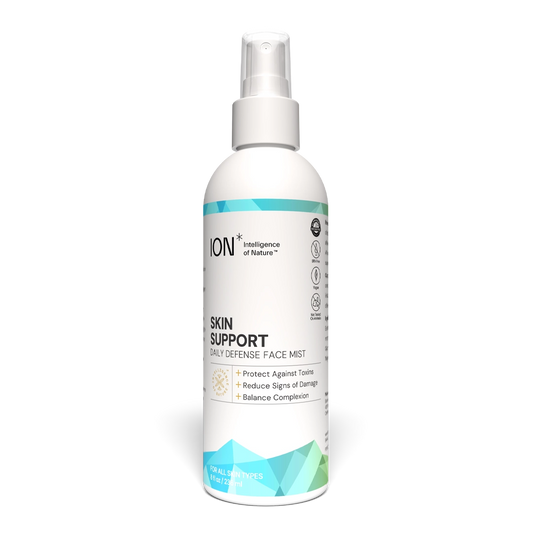
ION* Skin Support was designed with this in mind: to work with the skin's intelligent barrier, not to override it. When the barrier has what it needs to stay intact, everything else you do for your skin has a better foundation to work from.
What to actually look for — and look out for
The good news: label literacy goes a long way. Here's a practical starting point.
Worth seeking out
Look for "fragrance-free" — not "unscented," which can still contain masking fragrances. Prioritize short ingredient lists where you recognize most entries. Check the EWG's Skin Deep database before committing to new products; it rates thousands of personal care ingredients based on available safety data.
Worth avoiding
"Parfum" or "fragrance" without component disclosure. PEG compounds, which can enhance skin penetration of other ingredients. Oxybenzone in chemical sunscreens — flagged in EWG research for potential hormonal activity.
None of this requires a complete overhaul. Start with the products you use most often, in the highest amounts. That's where cumulative exposure adds up fastest.
A different kind of Mother's Day gift

Mother's Day is a moment to think about what we give the people who've spent years giving.
A gift that works with her skin's natural function — rather than adding to its load — is a quiet, meaningful shift. Not another product that promises transformation. Something that supports the foundation that was already there.
It's not just clean — it's proven
ION* Skin Support scored a perfect 100/100 on the Yuka app, which independently rates personal care products based on their ingredient safety profiles. No red flags. No hidden trade-offs. Just an ingredient list that holds up to scrutiny — the kind that's increasingly hard to find in a category full of fine print.

Backed by barrier science
ION* Skin Support isn't just free of the ingredients worth avoiding — it's actively designed to support what your skin already does.

Show details about this chart
Description:
This bar chart compares TEER (transepithelial electrical resistance) levels in skin cells under two conditions: normal skin cells and skin cells treated with ION Skin Support with a vertical axis of "Ohms (percent)".
Key findings:
- Normal skin cells show TEER levels of approximately 115%.
- Skin cells treated with ION Skin Support show TEER levels of approximately 180%.
- This represents a substantial increase in TEER with the addition of ION Skin Support.
What TEER means:
TEER (transepithelial electrical resistance) is a measure commonly used to assess the strength and integrity of a cellular barrier. Higher TEER values generally indicate stronger barrier function.
Accessibility note:
This text provides a descriptive alternative to the visual chart for users who cannot see the graphic. Values are approximate based on the chart visualization.
In TEER (transepithelial electrical resistance) studies, a gold-standard method for measuring skin barrier integrity, ION* Skin Support demonstrated the ability to help protect the skin barrier against environmental toxins. TEER measures how well a barrier holds together under stress — a higher resistance means a stronger, more intact barrier. This is the kind of data that goes beyond clean beauty marketing into actual barrier function.

After 12 weeks of use in a clinical study of 38 participants:


-
 69%
69%reported an improvement in their overall skin health*
-
 72%
72%reported an improvement in their fine lines*
-
 66%
66%noticed an improvement in skin texture*
-
 63%
63%noticed an improvement in their wrinkles*
*Based on self-reported data. Individual results may vary.
What a supported barrier looks like
The results of consistent barrier support aren't abstract. Skin that maintains its integrity holds moisture better, responds to irritants less, and over time looks more even, calm, and resilient.

For a limited time, get 20% off with code:
MOM20
Offer valid through Mother's Day. While supplies last.