

Most people who finish a round of antibiotics reach for a probiotic. That makes sense. Antibiotics wipe out bacteria, the bad kind and the good kind. Replacing what was lost feels like the logical next step.
But there's something else happening that probiotics alone can't address.
Your gut barrier — the lining between your digestive tract and the rest of your body — is under pressure too. And if it's not supported, no amount of bacterial reinforcement will fully close the gap.
The Part of the Story Nobody's Telling
Antibiotics are effective because they're designed to be aggressive. They interrupt bacterial processes quickly and broadly. That's what makes them work.
But your gut lining is lined with something called tight junctions — microscopic seals between the cells in your gut wall. These junctions act as your body's gatekeeper. They decide what gets through into your bloodstream: nutrients in, harmful substances out.
When antibiotics enter your system, they don't just affect bacteria. They also place stress on these tight junctions. The seals that normally stay tightly closed can become compromised, leaving your gut lining more vulnerable than before treatment began.
This isn't a fringe idea. It's a structural consequence of antibiotic use that often goes unaddressed in standard recovery guidance.

What Are Tight Junctions, Exactly?
Think of your gut lining as a wall made of cells pressed closely together. Between each cell, tight junctions act as the mortar. When they're intact, your barrier does its job — protecting your internal environment from whatever passes through your digestive tract.
When tight junctions are weakened, that wall becomes more porous. The barrier that's supposed to be selective starts letting things through that it shouldn't.
This is what's sometimes called a compromised barrier (aka leaky gut), and it's a key reason why gut health reaches beyond just digestion.
Why Symptoms Show Up Weeks Later
One of the most disorienting parts of post-antibiotic gut issues is the timing. You might feel fine right after finishing the prescription — and then experience digestive discomfort, skin changes, or mental fog weeks later.
That's not coincidence. It's the barrier.
When tight junctions are under stress, your system doesn't necessarily send loud, immediate signals. The effects accumulate. And because the symptoms — bloating, fatigue, skin flare-ups, difficulty concentrating — can look like a dozen different things, most people don't connect them back to the antibiotic course they finished a month ago.
Replacing Bacteria Isn't Enough
Probiotics support microbial diversity. That matters. But if your gut barrier is compromised, you're adding to a system that still has a structural vulnerability.
It’s kind of like pumping more air in a tire that hasn’t been patched. What goes in can still come back out.
Supporting the barrier itself — the tight junctions, the physical integrity of the gut lining — is a separate and necessary step. Not necessarily instead of probiotics, but definitely in addition to them.
This is the part of post-antibiotic recovery that most protocols miss entirely.

What Barrier Support Actually Looks Like
Supporting your gut barrier after antibiotics means giving your tight junctions what they need to maintain their integrity.
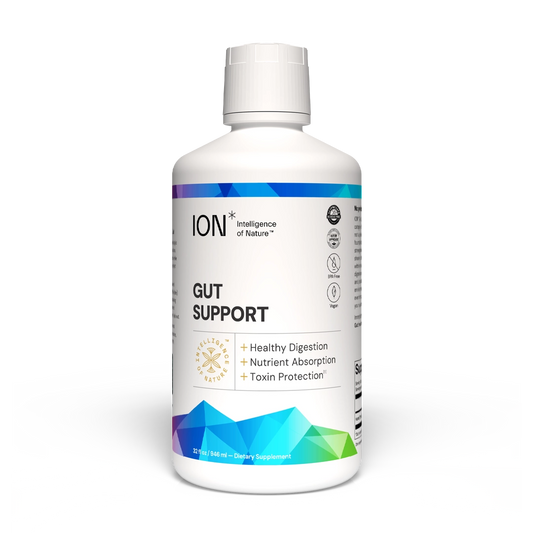
ION* Gut Support is formulated to do exactly this. It's not a probiotic. It's not a prebiotic. It works at the level of the barrier itself — supporting tight junction function so your gut lining can do what it was designed to do.
The formula comes from 60-million-year-old soil, rich in naturally occurring compounds that work with your body at a molecular level. Rather than adding to your system, ION* supports the intelligent architecture that's already there.
If you've recently finished antibiotics, or if your gut health has felt off and you can't pinpoint why, this is the place to start.
The Takeaway
Antibiotics serve an important purpose. But the recovery conversation needs to go deeper than bacterial replacement.
Your gut barrier has tight junctions that need support after antibiotic exposure. Without addressing this, the symptoms many people chalk up to slow recovery — brain fog, skin changes, digestive discomfort — can linger far longer than they should.
Go beyond probiotics and support your foundation first.