
That post-beer bloat isn't just in your head. And your Sunday morning regret? Your gut felt that coming the moment you cracked open that first cold one.
Beer hits your digestive system with a perfect storm: glyphosate residue from industrial farming, gluten proteins that challenge even non-celiac guts, alcohol that disrupts your barrier integrity, and carbonation that adds gas to an already compromised system.
The result? Bloating, discomfort, and a next-day experience that goes beyond just a headache.
The Hidden Ingredient Nobody's Talking About: Glyphosate
Here's something your favorite beer brand won't tell you: 19 out of 20 popular beers and wines tested positive for glyphosate—the active ingredient in Roundup herbicide. Even organic brands weren't exempt.
Testing by U.S. PIRG found glyphosate levels ranging from trace amounts to 51 parts per billion in wines and up to 49 parts per billion in beers like Tsingtao, with popular brands like Miller Lite, Corona, and Budweiser all containing 25-30 ppb.
So what? Well, for starters, Glyphosate acts like an antibiotic in your gut, disrupting the delicate balance of your microbiome. Research shows it kills beneficial bacteria while resistant pathogenic strains survive. It's also been classified as a "probable human carcinogen" by the World Health Organization's International Agency for Research on Cancer.
Every sip is exposing your gut barrier to a chemical that wasn't part of the original recipe. And it doesn’t stop there.

The Perfect Storm for Your Gut Barrier


The Quadruple Threat: Why Beer Is Uniquely Challenging
1. Glyphosate: The Gut Barrier Disruptor
Beyond killing good bacteria, glyphosate may function as an endocrine disruptor and has been scientifically shown to disrupt gut lining integrity. This causes a downward spiral of inflammation as foreign particles enter the bloodstream and cause even more damage.
2. Gluten: Not Just a Problem for Celiacs
Even if you're not celiac, gluten proteins can challenge your digestive system. When your gut barrier is already stressed, gluten becomes another variable your body has to manage. Many people report less bloating when they switch from beer to gluten-free options — and it's not always placebo.
3. Alcohol: The Barrier Breaker
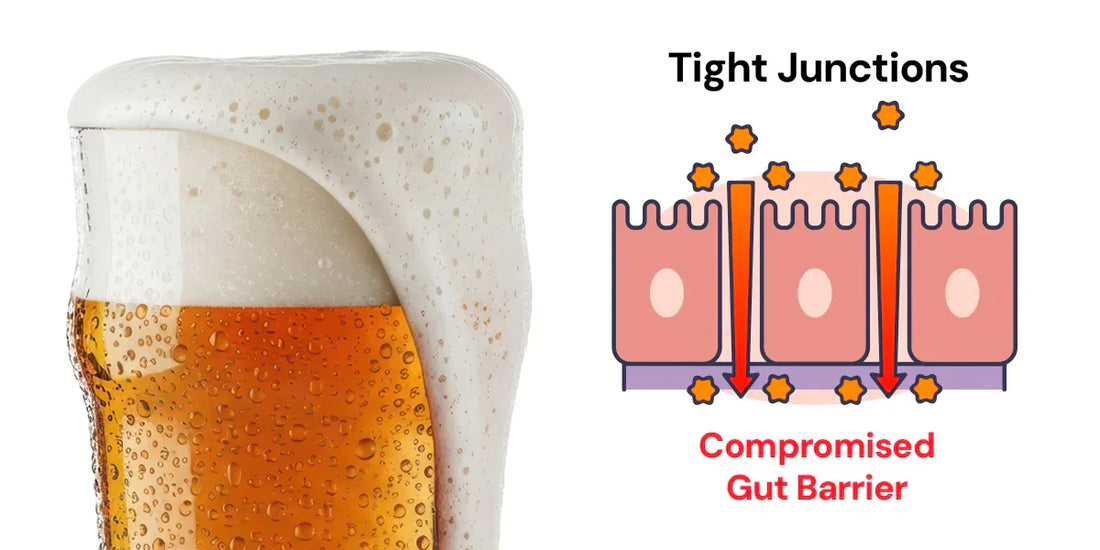
Alcohol directly impacts tight junction proteins, temporarily compromising your gut's selective permeability. This is why that 2 AM pizza hits different…your barrier literally can't protect you as well as it should.
But alcohol's effects go beyond the gut lining. It creates oxidative stress throughout your system, particularly in the liver where alcohol metabolism happens. The breakdown of ethanol produces acetaldehyde — a toxic metabolite responsible for many hangover symptoms — and generates reactive oxygen species (ROS) that damage cells.
4. Carbonation: Adding Insult to Injury
CO2 bubbles create mechanical pressure and gas that your already-challenged digestive system has to process. It's like asking someone with a sprained ankle to run a marathon.
The Morning After: What's Really Happening
When you wake up feeling rough after a night of drinking, it's not just dehydration. Your body is dealing with:
- Acetaldehyde buildup: The toxic metabolite of alcohol that causes nausea, headache, and fatigue
- Oxidative stress: Reactive oxygen species overwhelming your antioxidant defenses
- Disrupted sleep architecture: Alcohol suppresses REM sleep and causes more frequent waking in the second half of the night
- Inflammation: Your immune system responding to barrier disruption and oxidative damage
- Gut barrier compromise: Tight junctions that haven't fully recovered
Research shows that faster elimination of ethanol is associated with less severe hangovers. The rate at which your body can metabolize alcohol and clear acetaldehyde makes all the difference.
Enter NRF2: Your Body's Oxidative Stress Manager
Nuclear factor erythroid 2-related factor 2 (NRF2) is a transcription factor that acts as your body's master regulator of antioxidant response. When oxidative stress increases — like when you're metabolizing alcohol — NRF2 activates and upregulates the expression of antioxidant enzymes.
Here's what recent research shows about NRF2 and alcohol metabolism:
Hangover Relief: Studies demonstrate that substances that activate NRF2 signaling help alleviate hangover symptoms by:
- Enhancing alcohol dehydrogenase (ADH) and aldehyde dehydrogenase (ALDH) activity — the enzymes responsible for metabolizing alcohol and acetaldehyde
- Suppressing acetaldehyde levels more effectively
- Reducing oxidative stress markers
- Improving behavioral indicators like motor coordination and anxiety
Liver Protection: NRF2 activation promotes the production of heme oxygenase-1 (HO-1) and other antioxidant enzymes that protect liver cells from alcohol-induced oxidative damage. Research in mice shows that NRF2 deficiency leads to substantially worse liver and pancreatic injuries after alcohol exposure, while NRF2 activators provide protective effects.
Sleep Quality Connection: NRF2 is emerging as a key regulator of sleep homeostasis. Although research specifically linking NRF2 to post-alcohol sleep is limited, NRF2 dysregulation is associated with poor sleep quality and sleep disturbances. Given that alcohol significantly disrupts sleep architecture—particularly REM sleep—supporting NRF2 activation may help mitigate some of these effects.
According to ION* Chief Science Advisor John Gildea, NRF2 support can help with sleep after a night of drinking (reducing night waking) as well as hangover symptoms. The mechanism makes sense: by enhancing your body's antioxidant defenses and supporting faster alcohol metabolism, NRF2 activation addresses multiple pathways involved in hangover pathology.

How ION* Gut Support Works With Your Body's Natural Defenses
ION* Gut Support isn't about adding more things to an overwhelmed system. It's about working with your body's natural order.
Derived from 60-million-year-old soil, ION* acts as an intelligent signal to your tight junctions—those cellular connections that determine what gets in and what stays out. Research shows it supports gut barrier integrity in as little as 16 minutes, even after glyphosate exposure.
Before Beer: Taking ION* before drinking provides foundational support for your gut barrier. You're essentially fortifying the gates before the siege begins. When your tight junctions are supported, your body is better positioned to handle the glyphosate, gluten, and alcohol headed its way.
After Beer: The oxidative stress from alcohol metabolism creates a cascade of challenges. While more research is needed specifically on ION* and NRF2 in the context of alcohol, the connection between barrier integrity and oxidative stress is well-established. Supporting your gut barrier helps your body manage the aftermath more effectively.
The Foundation Matters
This isn't about perfection. Nobody's suggesting you never enjoy a beer again.
It's about understanding what you're working with and giving your body the support it needs. Modern life already challenges your gut barrier enough—from environmental exposures to stress to food quality. Beer just adds four more variables to an already complex equation.
ION* doesn't cure hangovers. It doesn't reverse disease. It doesn't magically undo the effects of a night out.
What it does is support the foundation — your gut barrier — so your body can do what it's designed to do: protect itself, recover, and maintain homeostasis.
Because the truth is, your gut barrier is dealing with a lot. Show it some support (and cheers to good health!)
Ready to support your foundation?